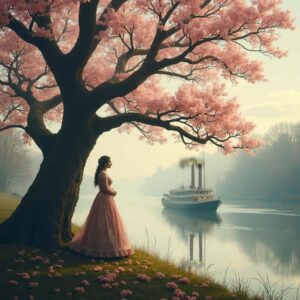
Dogwood Ghost — Part 1
It is the month of October, and the time of year more than any other time, we begin to hear stories and see images of ghosts. So, to stay with that theme I have a tale of mystery, love and yes perhaps even ghosts.
Nearly sixty-five years ago, I was a guest of Joe McCaskey and his wife Melis on a showboat that came to visit our fair community. The showboat tied up down by the old ferry landing, with its gangplank down to welcome guests for the boat’s nightly performance. It had come to town with a crew of college students working for the summer on board as part of an old-time riverboat theatrical show. Dancing, singing and minstrel acts were the events for the evening performance for the local citizens.
At that time Joe was head of the First National Bank on Main Street. He seamed to know every- one at that evening’s performance, including the boats captain. It was not long before he had arranged an invitation for us to visit the pilothouse of the showboat on the upper deck.
For a young boy this was a real treat to stand in a place that I could imagine Samuel Clemens may have stood as he navigated the waters of the Mississippi. As you can tell, even back then I had a vivid imagination. The wheelhouse was not fancy in appearance, but looking back it was practical for the job it had to do. The large wheel used to guide the boat on its journey up and down the river, showed signs of many hours of wear over the years.
But probably the thing I remember the most, were the large glass windows that surrounded the pilothouse on all sides. Inside, it was lit with lights that were low and soft. The captain indicated when traveling at night, most pilots have little or no light on the inside, so their eyes become accustomed to the darkness that surrounds the boat. When I looked out at the dark waters of the Ohio River, the only light I could see was from the homes on the far side reflecting across the water’s surface. In those days looking north on the river there was no dam and the new bridge was still not complete.
As I stood their looking into the dark night, Joe, who was standing next to me said, “did I ever tell you the story of the dogwood tree ghost?” Before I could answer, Joe’s wife placed her hand on my shoulder saying, “Don’t go scaring the boy Joe with your old ghost stories, he won’t be sleeping tonight!”
Joe explained it was not really a scary story, as much as it was one of the many forgotten mysteries of the river. Now, for those of you who may not have known who Joe was, suffice to say he seemed bigger than life to the kids of my neighborhood. He told stories of hunting and fishing among the woods and creeks of the area. Tales of early days in the Ohio Valley when Indians made their homes along the river. I always enjoyed his stories even if I kind of knew they might only be for our entertainment.
As well as I can remember, this is the tale told to me in a dimly lit wheelhouse looking out at the dark waters of the Ohio River. Now, I will have to admit to filling in the gaps in the story to help make it more interesting for this telling. But, every time a ghost story is retold, it may grow just a little, and if I knew Joe, he would not mind.
After the terrible war between the north and south, the new state of West Virginia would begin to play a role in the industrial growth along the Ohio River. Towns grew as coal, oil, timber was being shipped to the south, and loads of tobacco and cotton came north on the return trip.
During the war almost all the steamboats had been pressed into service as gun boats to patrol the river to help keep supplies, mail and soldiers moving up and down the river. After the war many of the boats returned to more commercial service as cargo and passengers once again moved freely on the waterways.
One such boat was called the Rose of Virginia. The Rose was over 2oo feet long and nearly sixty-five feet wide. The bottom decks were mostly open for large cargo or livestock. During the war, Federal Cavalry traveled south aboard the Rose to try and capture the Confederate raider, John Morgan in the battle of Buffington Island.
On this day no frills adorned her decks, as she now was mostly used for cargo. She still had a few rooms on the upper deck for passengers coming north to find work in the steel mills, or coal mines in the Ohio Valley. The rooms could accommodate twenty passengers who did not mind if those first-class rooms of yesterday were now just bunk bed rooms. The dining room near the front of the boat still was where the passengers could eat their meals. The small stage that sat in the front of the once formal dining area was now dismantled, and long forgotten. Before the war, traveling groups of Shakespearean players, or musicians worked off passage expenses with stage shows for the paying passengers. But the once ornate stage, and crystal chandeliers were long gone since the war.
At the front on the top deck, two rusty blackened smoke stacks still showed evidence of bullet holes from Confederate gunfire. Behind the stacks was the pilothouse where the captain guided his boat around constant tree snags, and ever-changing sand bars on her travels.
The Rose was built in Pittsburgh in 1856. During her original construction, she was built with an extra wide hull, and with four oversized boilers to drive her massive paddlewheel. She was going to be commissioned as a river snag remover when her construction first began. But the owners saw more profit for her as a heavy cargo carrier, than as a government river snag remover.
The captain had piloted the Rose for five years before the war. Those years she carried steel from the Pittsburgh mills south, and returned with heavy loads of cotton and tobacco from towns along the Mississippi.
During the war she was converted into a gunboat with four heavy cannons mounted on her lower deck. Heavy oak planks covered the sides to protect her from gunfire and small cannons hidden along the river’s banks.
After the war she would return to limited passenger service and continued to carry heavy cargo up and down the river.
It was in the spring of 1867 that the Rose of Virginia and her Captain made a stop in the small town of New Martinsville to unload cargo for the oil fields. Next week Part 2
Columns by Chuck Clegg
A Time To Honor
Each year on November 11th, we as a nation have set aside the day to remember and Honor the American Veteran. We ...
Thank God, No More Political Commercials